 Sarah Miller
A pair of newly disclosed vulnerabilities in PHP has triggered one of the most serious web security emergencies in years, potentially exposing a huge portion of the public web to remote attacks.
The vulnerabilities, dubbed PHP2Shell, allow unauthenticated attackers to potentially execute arbitrary code on vulnerable web servers. Both have received a critical CVSS 4.0 severity score of 9.2.
The PHP project released emergency fixes on October 21 and is urging every organization running PHP to update immediately. The affected surface is extraordinarily broad: PHP powers roughly 69% of websites whose server-side programming language is known, according to W3Techs, and sits underneath widely deployed platforms including WordPress, Drupal, Joomla, Magento and numerous custom applications.
The incident is noteworthy for another reason: artificial intelligence helped discover it.
According to The Wall Street Journal, security researcher Ryan Austin of Calif uncovered the flaws while using OpenAI's GPT-5.6 Sol to audit the PHP source code. The underlying problems had existed for years and were previously considered extremely difficult to exploit. AI helped researchers turn that theoretical weakness into a practical attack path.
That makes PHP2Shell both a cybersecurity emergency and an early warning about what software security looks like in the AI era.
From Bug Discovery to Exploit at AI Speed
The two vulnerabilities, CVE-2026-109618 and CVE-2026-109619, involve PHP's handling of memory and internal state.
One involves memory corruption caused by out-of-memory handling interrupting PHP while request data is only partially initialized. The second involves request state surviving after its underlying memory has been freed. In both cases, researchers found paths that can ultimately lead to remote code execution.
That's about as bad as a web vulnerability gets.
An attacker potentially doesn't need credentials or an existing foothold. In the highest-risk configuration identified by the PHP project, an unauthenticated request can trigger the vulnerability before the application itself even begins executing.
The problem is already moving beyond the theoretical. Cloudflare has reported seeing early attacks and has deployed Web Application Firewall rules as a temporary defense. Government websites in Europe have been taken offline as a precaution, while cybersecurity agencies have advised organizations that cannot patch immediately to consider disconnecting affected systems from the public internet.
PHP has now released patched versions 8.5.12, 8.4.27, 8.3.36 and 8.2.35. The PHP project says there are no complete mitigations and that upgrading is the only safe choice.
Organizations running PHP should therefore treat patching as an immediate operational priority.
But enterprise technology leaders should also ask a longer-term question.
Is It Time to Reconsider PHP for Enterprise Websites?
PHP has been enormously successful. It helped democratize web development and became the foundation for an enormous ecosystem of CMS platforms, applications, plugins and hosting providers.
That ubiquity is precisely why PHP2Shell is so consequential.
It also highlights the technical debt hiding beneath a substantial portion of the web.
For organizations running a small marketing site, replacing an entire technology stack because of a single vulnerability would be an overreaction. Every major software platform has vulnerabilities, and Java certainly isn't immune from CVEs.
For enterprises operating large, mission-critical digital experiences, however, PHP2Shell should prompt a more fundamental architecture review.
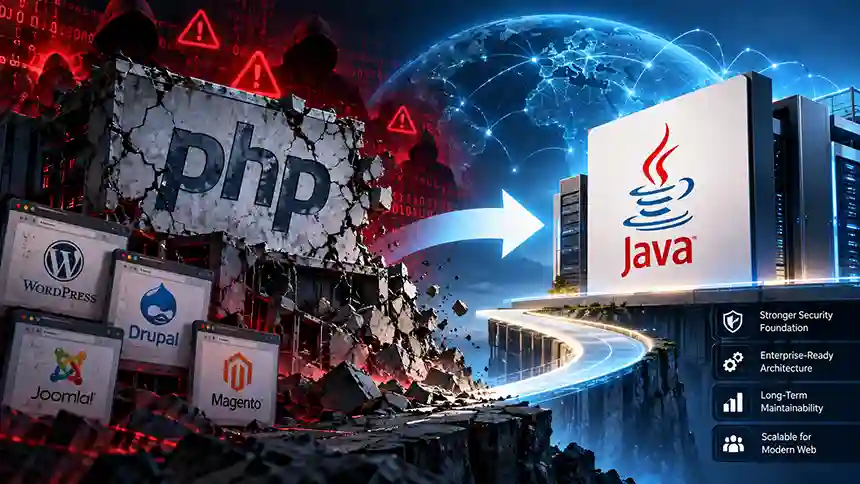
In many cases, it may be time to get off PHP and move the enterprise web tier to Java.
The argument isn't that Java cannot be compromised. It can. The distinction is architectural.
Java was designed around a managed runtime with automatic memory management, type safety and array bounds checking. Oracle's secure-coding guidance specifically notes that these characteristics make pure Java code highly resistant to traditional memory-corruption attacks.
That matters because PHP2Shell is rooted in exactly the kind of low-level memory-management behavior that managed runtimes are designed to abstract away from application code.
Java also has decades of adoption in environments where software lifecycle management, dependency control, observability, testing, access control and long-term maintainability are treated as enterprise engineering disciplines rather than simply website administration.
That does not eliminate security risk. It changes the engineering foundation on which that risk is managed.
The CMS Architecture Matters Too
The issue goes beyond programming languages.
Many organizations still operate websites built around monolithic PHP CMS architectures in which the content management system, rendering engine, application logic, plugins and public-facing website are tightly coupled.
That creates an enormous attack surface.
A vulnerability in the underlying runtime, CMS core or one of potentially dozens of plugins can expose the production website itself.
Modern enterprise CMS architectures can dramatically reduce that coupling.
A Java-based headless or decoupled CMS, for example, can separate the authoring environment from public content delivery. Content can be published into independently scalable delivery infrastructure while the management tier remains isolated from the public internet.
That doesn't make the system invulnerable. It does mean a website doesn't have to be a publicly exposed CMS application.
For security-conscious enterprises, that distinction is increasingly important.
AI Changes the Security Equation
Perhaps the biggest lesson from PHP2Shell isn't PHP at all.
It's AI.
Security researchers have always had an advantage when they can spend weeks or months analyzing source code and constructing sophisticated exploits. AI dramatically compresses that timeline.
The same models developers use to understand unfamiliar code can be used to search millions of lines of open-source software for subtle vulnerabilities, reason about unexpected state transitions and construct potential exploit chains.
That is good news when defenders find the vulnerabilities first.
It is considerably less comforting when attackers do.
PHP2Shell demonstrates the beginning of an era in which obscure bugs that survived for years because they were simply too difficult or time-consuming to exploit may suddenly become practical targets.
The security assumptions underlying legacy web infrastructure therefore deserve another look.
Patch Today. Modernize Tomorrow.
For anyone operating PHP infrastructure, the immediate response is straightforward: identify every internet-facing PHP system and upgrade it now. Unsupported PHP versions should be treated with particular urgency. The PHP project itself notes that PHP 8.1 and earlier no longer receive normal project security updates, although some operating-system and long-term-support vendors may provide backported fixes.
But once the immediate fire is extinguished, enterprise architects should resist treating PHP2Shell as just another CVE.
The web technology landscape has changed enormously since PHP and the first generation of monolithic web CMS platforms became dominant.
Enterprise websites today are critical applications. They handle customer data, transactions, authentication, integrations and increasingly AI-powered experiences. They deserve an application architecture designed accordingly.
For organizations already carrying years of PHP and legacy CMS technical debt, PHP2Shell may be a useful catalyst.
Patch the PHP server today. Then start asking whether you really want to be running your enterprise website on PHP tomorrow.
For many enterprises, the better long-term answer may be a modern, decoupled architecture built on Java.