 Tom Jackson
Google's vice president of product for Search, Robby Stein, announced on X that a collapsible sidebar is rolling out on the Google desktop homepage globally, so people can "easily find & jump back into" their recent AI searches. We have not seen an official post on Google's Search blog for this change. The coverage, including The Verge and Search Engine Land, is based on Stein's post and the video he shared.
That sounds like a small interface tweak. It is more than that. Google is putting resumable AI Mode conversations on the first page most desktop searchers see. If those threads become the place people return to, the referral path for a website is no longer just a fresh results list. It is a citation, or a follow-up, inside a conversation that can now be picked up again.
What Google Shipped On The Homepage
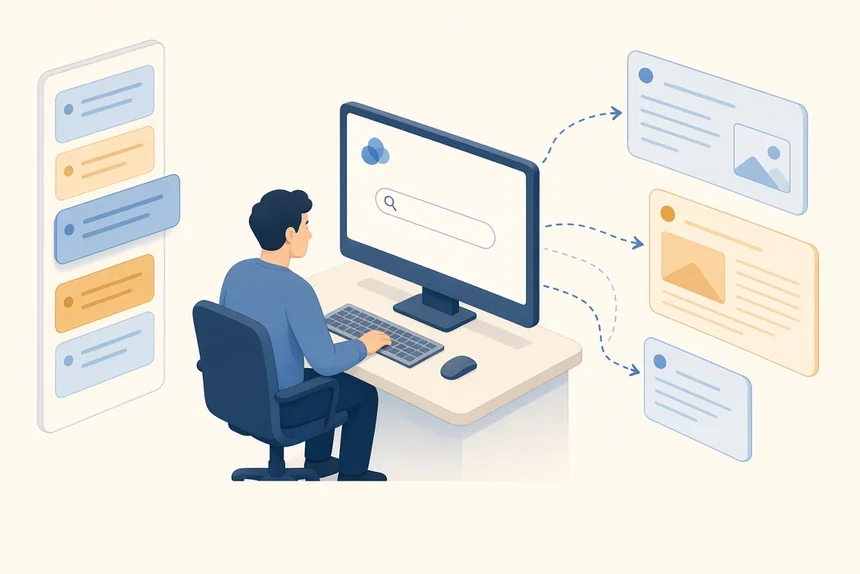
Stein's video, as described by The Verge and Digital Trends, shows a thin bar on the left edge of google.com. Opening it reveals a list of recent AI Mode chats, plus ways to start a new thread, search older threads, and connect a Gemini Notebook. Clicking a thread opens it in AI Mode so the person can continue. The logo and search box stay in the center, and the sidebar can be collapsed.
Stein said people are coming to Search with "more questions that aren't just one and done," and that "in testing, this sidebar made a big difference for making progress & continuing to explore the web." That testing claim is Google's. The company did not publish the test design, the metrics, or any traffic numbers for the sidebar. The announcement is for the desktop homepage only. Stein did not say when it will reach every account, or whether a similar panel is coming to mobile. Search Engine Roundtable had already spotted an AI Mode sidebar under test on the main results page in October. Two days earlier, Google also added temporary threads in AI Mode, which are not saved to history, so not every session will appear in the new sidebar.
What The Click Data Already Shows
The sidebar is new, and there is no published measurement of how it changes clicks to websites. The evidence we do have is about Google's AI answers in search, mainly AI Overviews, and about the scale Google claims for AI Mode.
Earlier this year in May, Google said in its I/O Search post that AI Mode had surpassed one billion monthly users, and that AI Mode queries had more than doubled every quarter since launch. Those are the company's figures. The same post said people can already follow up from an AI Overview into an AI Mode conversation, with context kept as they go deeper. A homepage history list makes that kind of session easier to resume.
The click research we can cite is about AI Overviews, not about this sidebar, and it is not encouraging for publishers. A Pew Research Center analysis of browsing data from 900 U.S. adults in March 2025 found that people clicked a traditional result on 8% of visits when an AI summary was present, compared with 15% when it was not. They clicked a source cited in the summary itself in only 1% of those visits, and they were more likely to end the session after a page with a summary (26% versus 16%). Pew notes the data is observational. Ahrefs, using aggregated Search Console data for 300,000 keywords, estimated that an AI Overview was associated with a 34.5% lower average click-through rate for the top-ranking page, compared with a forecast based on similar informational queries, from March 2024 to March 2025.
The pattern is consistent: when Google answers in place, fewer people click out. If the homepage now invites people to continue an AI Mode thread instead of starting a fresh, link-heavy search, sites should not assume referral volume will rise just because Stein says people will "continue to explore the web."
What Web Teams Should Do Next
Treat AI Mode, like AI Overviews, as a place you want to be cited, not only a place you want to outrank. That is the same shift we discussed earlier this year in our look at SEO and generative engine optimization: audience behavior is already moving toward answers and conversations. The work is to make pages a model can quote accurately, and that a person might still want to open.
Write pages that can be cited. Lead with a clear, current answer, then the supporting detail. Keep definitions, product facts, pricing and dates in one canonical place, and use structured data where it helps machines parse the page. Original data and worked examples still give a model something specific to point to. Plan for follow-up questions, not only the head query. If someone is comparing options or debugging a setup, the next turn in the thread may be more specific than the first. Cover those adjacent questions on the same page or in a tightly linked cluster.
Measure what you can, and do not invent a metric Google does not give you. Watch Search Console click-through rates on informational queries, especially where you already see AI Overviews. In analytics, separate referral traffic and landing pages, and watch sessions that arrive from Google after longer, question-shaped queries. There is still no official way, as Ahrefs has noted, to split AI Overview clicks from ordinary search clicks in Search Console. For other assistants, OpenAI's Business Hub now reports aggregate mentions and website clicks, which is a start, not a replacement for Google data.
The rollout is gradual and, for now, desktop-only. Use the next few weeks to baseline your informational click-through rates and referral trends, then compare after the sidebar is widely visible. If your traffic depends on being the click after a one-shot query, this is the moment to make sure you are also the source a resumed conversation can still send people to.